Post 1
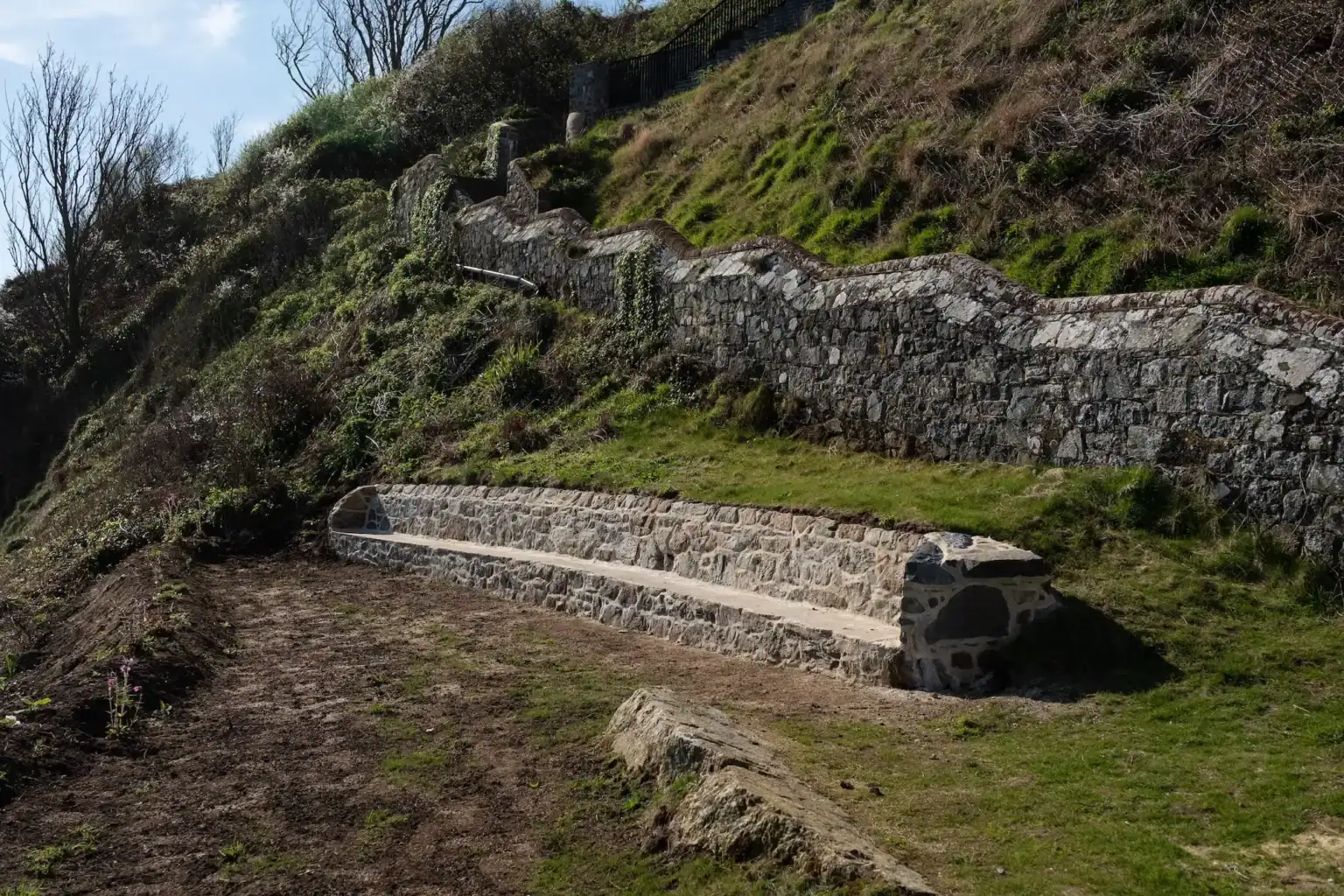
Literary Bench
History of La Vallette
Traces of the Vikings
There is no doubt that the Islands experienced Viking raids. There is however little record of this. The main way that the "Northmen" seem to have left their mark here is with the place names that we still use.
The Ancient Names of the Channel Islands (Richard Coates)
- The -ey in Guernsey, Jersey, Alderney and Chausey comes from the Scandinavian "ey", an island.
- The first part of the name may well derive from a personal name. The first written form of "Guernsey" was recorded as "Greneroy" in a document of around 1030, and the name may have been derived from the Scandinavian name Grani or Grener, and may have been the name of the Scandinavian chief who acquired the island, around the year AD 930.
- Some of the smaller islands (Jethou, Brecqhou, Lihou etc) received names ending in -hou, a suffix derived from the Scandinavian word holm, a small island.
- Interestingly, the islands visible from here that did not acquire Scandinavian names are Herm, and Sark.
Literary Route
The Book of Ebenezer Le Page
Ebenezer Le Page and Lisa Queripel are overwhelmed by the beauty of this place.
She wanted to sit down and we sat on the furthest seat on the grass along Havelet by the tunnel. … There was very few people about, and none came as far as where we were sitting. The sun was setting on the other side of the island, and the sky over our heads was streaks of gold; and there was a purple mist low down. I remember how we sat and watched the lights come up along the Esplanade and round the harbour and on the ships in the Pool.
"It's lovely here," Liza said in a whisper. "Yes," I said. I had to whisper too: everything was so still. The long island of Sark was only a shadow, and a shadow was creeping across the wide meadow on Herm, and Jethou was a dark hump I could only just make out, when the moon began to rise out of the mist. It was only the tip at first; but it grew and grew until it was big and round and copper-coloured, and the light from it upon the sea and upon the islands was a glory I cannot speak. There was no words passed between us, and we wasn't even touching; yet I felt she was near to me, nearer than any woman have every been, before or since.
Unfortunately, their love was not to be.
In desperation I thought I would go for a walk down Havelet and sit on the seat where Liza and me had sat that night. I don't know why I got that daft idea into my head, or what good I expected it would do me. I was well past the slaughter-houses, before I realised what a fool I was being. Liza wouldn't be there. That once in our lives we had come close together, but the battle had started again, and we had gone apart. It was no use crying over spilt milk.
Plant Spotter
Seashore
Plants that live just above the strandline are faced with challenging conditions. They must be hardy and drought and salt tolerant to thrive near to the coast.
Plants here include Rock Samphire, Sea thrift, Sea campion, Mexican daisy, Navelwort.
Cliffs
It is amazing to see the plants that squeeze themselves into the little cracks and crevices of these huge rocks. There are a surprising range of species that have adapted to live in this harsh environment. These natural spaces provide just enough room for roots to anchor, and once securely rooted, the plant can stabilise itself and then draw nutrients and water from its surroundings. The rocks provide protection against wind, frost and excessive water.
Before most plants can grow on bare rocks, mosses and lichens pave the way. These organisms are the first to colonize rocky surfaces, surviving in extreme conditions and gradually breaking down the rock into a thin layer of soil.
Overtime, this soil makes it possible for larger and more complex plants to thrive in rocky habitats.
Here's a few facts about Lichens:
- Lichens can occur in areas where few other species can survive.
- They are slow growing and can live for centuries.
- They obtain nutrients from rainwater, dust and even bird droppings!
- Lichens provide food for many species and nesting material for birds.
- In areas with high levels of pollution only a few tolerant species will survive, so the presence of lichen is a positive sign.
Walking for Health
Seashore
Listening to the sea can be a meditative experience. Try to close your eyes and focus on the rhythm of the waves rolling in and out, maybe matching your breath to the sound. You might also sit quietly for a moment and notice the other noises that surround you, as seabirds call overhead.
The sea is not always calm – sometimes it can be very fierce indeed! However, start this walk by connecting to the sounds around you, and connecting to your breath, and noticing how this simple act can begin to slow down your pulse and your mind.
Clarence Battery Steps
Step work to raise your heart rate – Now, it is time to take on the main challenge of the trail – the Clarence Battery steps! Let's get our pulses racing as we climb to the top of these steep steps.
Read the poem on the steps and then look back down to see how far you have come!
Rocks and Geology
Let’s go rock spotting!
There’s no rush, the rocks are not going anywhere soon. Some of the paths and steps might be slippery so take care and don’t run.
Do you know how fast the tectonic plates move? At the mid-Atlantic Ridge in Iceland, it is about the speed that your fingernail grows – and that is fast in geological terms!
You are at a geological fracture zone where massive tectonic forces deep underground causing super heating, compression (squashing) and ripping apart of rocks. Those rocks are now at the surface and you can see them along the trail.
One of the main rock types here is Gneiss (pronounced ‘Nice’). The bedrock outcrops are Metamorphic and are very, very old. The Gneiss at La Valette is called Icart Gneiss because you can also find it at Icart Point and at Saints Bay beaches.
The Gneiss here is among some of the oldest rock on the planet!
Have a guess how old it is?
Clue, it is more than 1billion years old, that is a lot of zeros!
(answer 1,200,000,000)
The other main rock type here is Igneous and is typical of the northern Guernsey Granite. It is up to 570million years old and tends to be pinker (feldspar), whiter (quartz), or dark grey/blueish (mica) depending on the minerals within the rock.
Can you see the netting to hold back the rock falls. What makes rocks fall from the cliff? Clue – There are 3 main types of weathering, plus gravity. Answer – physical (e.g. frost, heat and abrasion), biological (actions of plant roots or animals) and chemical (acids formed from rain) weathering.
How did the engineers fix the nets?? (answer – power drills and huge bolts)
Art Trail by Guernsey Arts
Inspiration on the steps
The walk up to Clarence Battery has been an inspiring place for many creative people. It’s a beautiful place with lots to look at and listen to around you, from the very bottom (what a perfect place to sit and write), all the way to the Clarence Battery itself, with views across the Islands on the way up.
As you walk up the steps, you’ll find a poem by Chloe Gallie. She wrote this poem inspired by these very steps and this area using words about the surrounding area to show how she feels while walking up the steps.
Poems can be any size and length, and don’t even have to rhyme! Sometimes they are about what you can see, sometimes they are about what you are feeling. Going for a walk is a great way to be gain inspiration.
Having a go at writing your own poem
Find somewhere along the steps or nearby where you feel comfortable stopping.
Come up with 5 descriptive words about this area. E.g. – bright – salty – plants – steep – wild
Use the words to make your poem – our example is going to be 5 lines long. (Remember it doesn’t even have to rhyme!)
I once stumbled upon a wild view
The salty spray flew back to me
The sun shone down on my back, bright and warm
And the plants danced as I found my path
Up the steep, steeps, steps that led me out of the storm
There’s no right or wrong way to do this – it’s just fun to have a go!
Did you enjoy using this spot to write a poem? Why not have a go at other spots along the trail!
Guernsey Arts is a not-for-profit organisation which aims for the Bailiwick of Guernsey to be the most vibrant artistic community it can be, across all aspects of the arts. From photography and film to live music and theatre; from sculpture and visual arts to poetry and literary works, if it's an art form, the Guernsey Arts team is on hand to help Bailiwick projects and creatives reach their full potential.
With the strapline Promote, Support, Inspire, the team aims for everyone, regardless of age or background to have access to the arts.
Contact us on Info@arts.gg or see our website www.arts.gg for our Cultural Calendar!