Post 10
Le Creux de la Morte Femme
History of La Vallette
La Vallette used to be an impenetrable rock face, providing some degree of protection to St Peter Port, from the prevailing winds and from invading forces. St Peter Port was said to sit in a "natural amphitheatre" with the cliff forming the edge of the town, making a wall on this side unnecessary for the medieval town.
With the development of the harbour, between approximately 1830–1870, large quantities of stone were needed. Much of the stone used was taken from the La Vallette area. This was carried out by the States of Guernsey with permission from the War Department who owned the land.
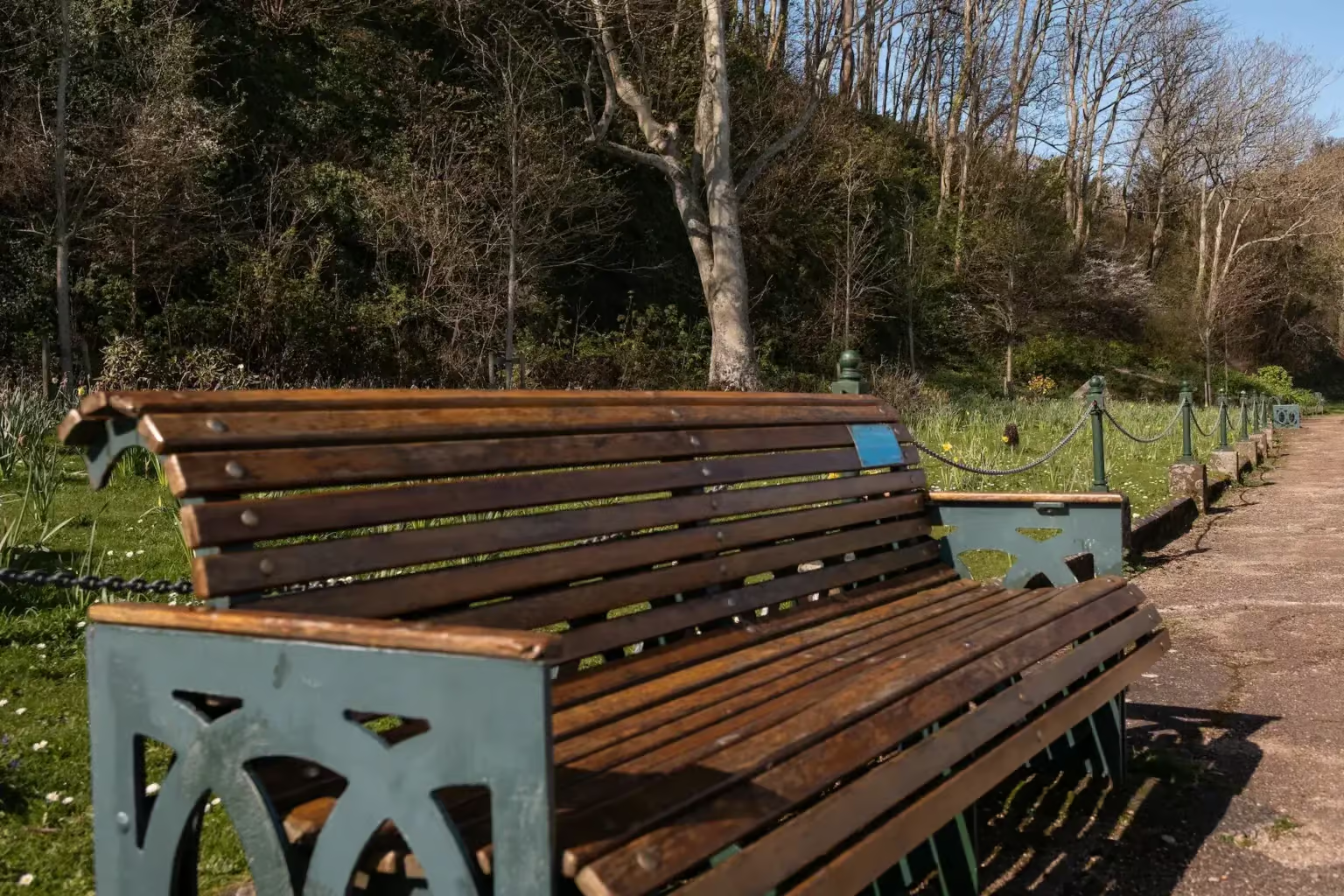
A tunnel was initially planned here, but removal of the entire section of rock face was found to be technically more straightforward. As part of the development, a garden and walking promenade was created.
An interesting footnote to this is the area just beyond the Gentlemen's Pool — a small rocky inlet can still be seen between the two large mounds of rock that have been left. This has the intriguing name of "La Creux de la Morte Femme" — the Cave or Inlet of the Dead Woman. No further information about the origin of this name can be found — it appears to be a mystery lost to time.
Literary Route
Victor Hugo — Toilers of the Sea
The 'Havelet' was one of these creeks. This little harbour (which is the signification of the word) was near the town, but was so solitary that it seemed far off. This solitude was owing to the shelter of the high cliffs of Fort Saint George, which overlooked this retired inlet. The Havelet was accessible by several paths. The most direct was by the water's side. It had the advantage of leading to the town and to the church in five minutes' walk, and the disadvantage of being covered by the sea twice a day. The other paths were more or less abrupt, and led down to the creek through gaps in the steep rocks. Even in broad daylight, it was dusk in the Havelet. Huge blocks overhanging it on all sides, and thick bushes and brambles cast a sort of soft twilight upon the rocks and waves below. Nothing could be more peaceful than this spot in calm weather; nothing more tumultuous during heavy seas. Thanks to recent improvements, this wild nook no longer exists. Fine, straight lines have taken the place of these wild features; masonry, quays, and little gardens have made their appearance; earthwork has been the rage, and taste has finally subdued the eccentricities of the cliff, and the irregularities of the rocks below.
Rocks and Geology
The flat terrace area was once a quarry that was used to create the breakwater and harbour at St Peter Port in the 1800s.
Without the quarrying and the engineering to create this safe harbour, Guernsey would be a very different, less busy and less successful community. Quarrying was a major industry for Guernsey in the 19th Century, with granite being exported for road making and even used for the steps of St Paul’s Cathedral!
As you head back to La Valette, take a moment to appreciate how steep the cliff face (or scarp) is and remember that you are looking at VERY old rocks at the interface of Guernsey’s Granite and Gneiss.