Post 7
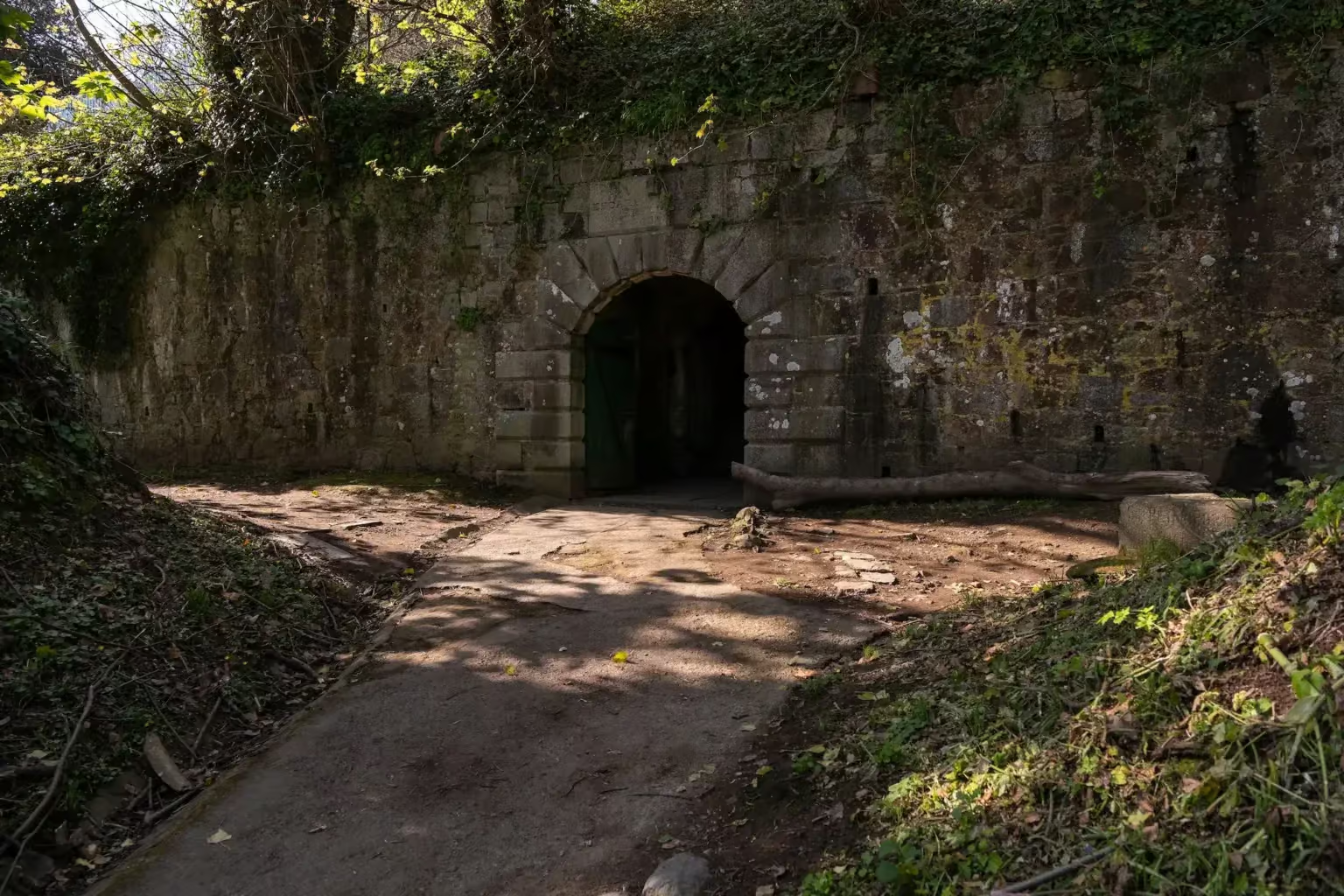
Belvedere Archway
Bugs and Beasties
Leaf litter and log piles
By attracting and providing a home for various insects, rotting wood, leaf litter and log piles increase the biodiversity of your garden. As well as solitary bees, ladybirds, beetles, spiders and pupating caterpillars, they can encourage other wildlife (like frogs, hedgehogs etc.) to come and visit.
Usually these spaces seem very quiet, although you might see some solitary bees at certain times of year. Please don't disturb their home! However, there are some great resources available to help you build your own, with lots of different ideas that mean they can fit into almost any size space.
How to Make a Bug Hotel: DIY Bug Hotel Ideas
History of La Vallette
Just down from this junction is a viewing platform with a fine view out over the harbour.
The area around St Peter Port has a long history of settlements due to the natural safe port here. Such are its geographical advantages it has probably always been the main port of the island. Evidence has been found, for instance, of Iron Age settlements at King's Road, a Bronze Age fort at Jerbourg, and the remains of a Roman settlement in the centre of St Peter Port were found during excavations carried out prior to redevelopments in the 1980s and 1990s.
On the seabed, at the entrance to St Peter Port Harbour, part of the hull of a Roman-era trading ship was found. This evidence shows that St Peter Port (whose Roman name is not known) was one of the ports visited by trading ships carrying cargoes along the Atlantic coast of Gaul (Roman France) and across the English Channel to Britain.
In 1372, Owen of Wales, with 3,000 Spanish mercenaries, invaded the island via Vazon Bay and fought their way down to outside St Peter Port. The battle here was fierce — led by Edmund Rose, 800 Guernseymen held back the invaders, until "the valley ran with the blood of the dead and injured". It is not clear exactly where the battle took place — local historian Gillian Lenfesty places it at the top of Havelet. The Guernsey force eventually retreated to Castle Cornet, where they lay in siege until the French king ordered Owen to move on.
Literary Route
Just down from this junction is a viewing platform with a fine view out over the harbour. Here are quotations from two very different writers describing the harbour of St Peter Port.
Victor Hugo — Toilers of the Sea
The harbour of St Peter's Port is one of some importance at the present day. Years ago it was enclosed by two enormous thick walls, beginning at the water's edge on both sides, and curving till they almost joined again at the extremities, where there stood a diminutive lighthouse painted white. Under this lighthouse, a narrow gullet, bearing still two rings of the chain with which it was the custom to bar the passage in ancient times, formed the entrance for vessels. The harbour of St Peter's Port might be well compared to the claws of a huge lobster opened a little way. This kind of pincer took from the ocean a portion of the sea, which it compelled to remain calm. But during the easterly winds the waves rolled heavily against the narrow entrance, the port was agitated, and it was better not to enter.
Mary Ann Shaffer — The Guernsey Literary and Potato Peel Pie Society
The harbour, with the town traipsing up steeply to the sky, must be one of the most beautiful in the world. Shop windows on High Street and the Pollet are sparklingly clean and beginning to fill up with new goods. St Peter Port may be essentially drab at the moment — so many buildings need restoring — but it does not give off the dead-tired air poor London does. It must be because of the bright light that flows down on everything and the clean, clean air and the flowers growing everywhere — in fields, on verges, in crannies between paving stones.
Walking for Health
Stop for a minute
It is not always possible to take a minute to look and listen to the world around you. So take this moment to do so. Just down from this post there is a beautiful view back towards the town of St Peter Port. Use this time to notice the signs of the changing seasons — the leaves on the trees, the sounds of birds, the clouds in the sky.
Extend your walk
Why not try walking a little further? From this point there are many alternative routes that you could take if you are in the mood for a longer walk. Perhaps head up through the Belvedere Archway to find a large open field, known as Belvedere Field, and a viewing area. Following the path up the hill, you will find an imposing large archway on your right-hand side, which used to be the main entrance to Fort George. Heading through the archway will lead you to a path, running parallel to the main Fort Road, which is a pleasant route for walking and can lead you on to other points of interest such as the Bluebell Woods and the Fort George Military Cemetery.
Part of Fort Field is managed for nature by the Pollinator Project. Find out more about this project on their website here – Fort Field – what’s going on? – Pollinator Project